

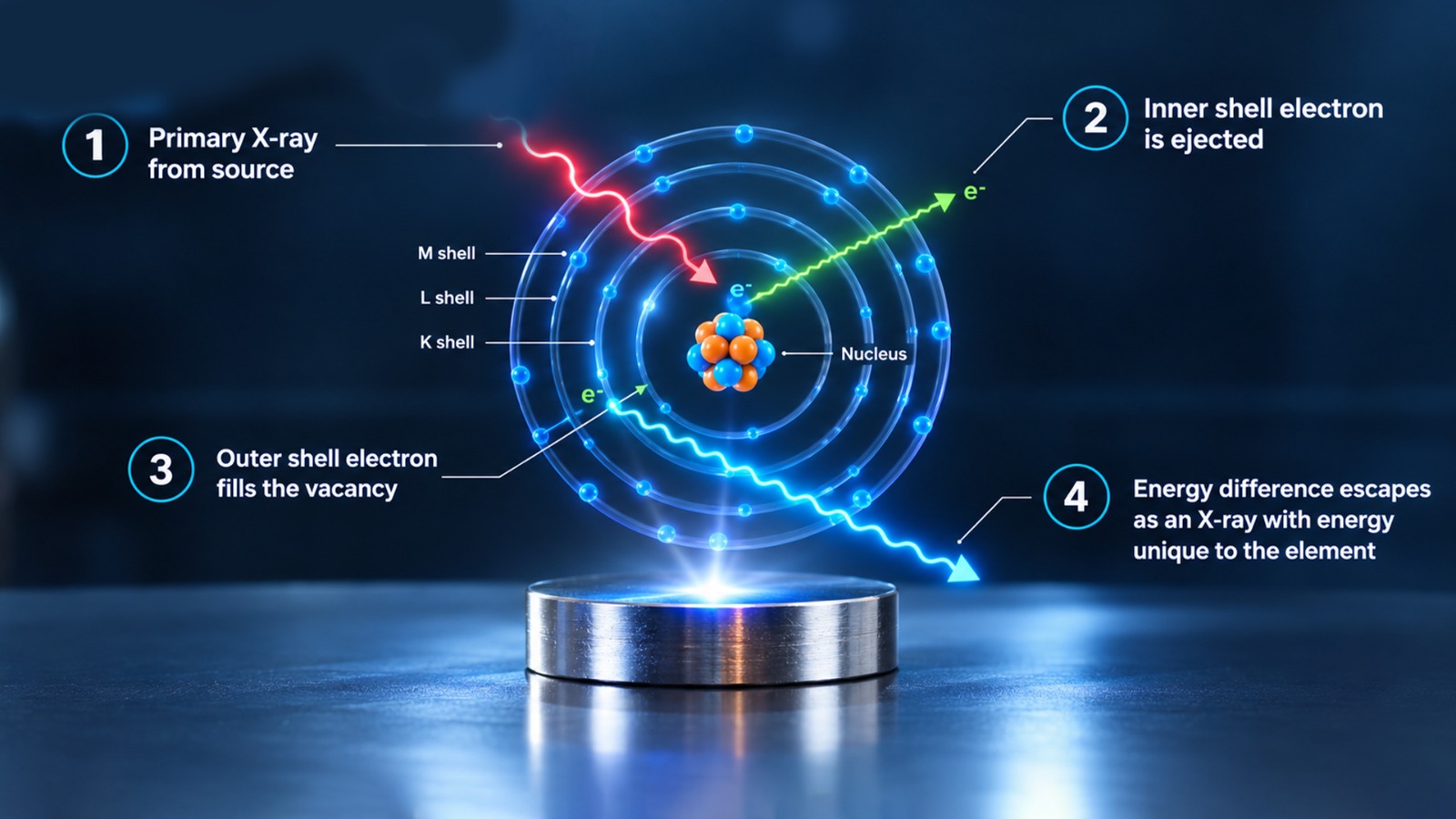
X-ray fluorescence (XRF) is an analytical technique used to identify the elemental composition of materials quickly and efficiently. It is widely used in industries that require accurate material identification, quality control, and elemental analysis, including jewellery, metal manufacturing, electronics, mining, recycling, and environmental testing.
One of the major advantages of XRF technology is its ability to analyze suitable materials without typically damaging or consuming the sample. This makes it particularly useful for testing valuable items, finished products, and industrial components that need to remain intact.
Modern energy-dispersive X-ray fluorescence (EDXRF) analyzers use an X-ray tube to excite atoms within a sample. The resulting fluorescent X-rays provide information about the elements present in the material. Depending on the instrument’s configuration, XRF can detect a range of elements and measure their concentrations, from major constituents to low-level trace elements.
Understanding how XRF technology works, where it is used, and what affects its performance can help businesses select the right analytical equipment for their testing requirements.
What Is XRF Technology?
X-ray fluorescence is a technique that identifies elements by measuring the characteristic X-rays emitted by a material after it is exposed to high-energy radiation.
Every element has a unique atomic structure. When an atom is excited by X-rays, an electron may be removed from an inner electron shell. An electron from a higher-energy shell can then move into the vacant position, releasing energy in the form of a fluorescent X-ray.
The energy of this emitted X-ray is characteristic of the element involved. By measuring these energy signals, an XRF analyzer can identify the elements present in the sample.
The instrument can also estimate the concentration of individual elements by analyzing the intensity of their characteristic signals and applying appropriate calibration and analytical methods.
Many modern handheld and benchtop analyzers use energy-dispersive X-ray fluorescence technology. The range of detectable elements depends on the detector, X-ray source, instrument configuration, sample characteristics, and testing conditions. Some EDXRF instruments can analyze elements across a broad range, potentially from sodium to uranium, although not every instrument can measure every element with equal sensitivity.
How Does XRF Technology Work?
XRF analysis is based on the interaction between X-rays and atoms. The process can be understood through three main stages.
1. Excitation of the Sample
The first stage involves directing X-rays from an X-ray tube towards the sample. The incoming radiation transfers energy to atoms within the material.
When the energy is sufficient, an electron from an inner electron shell may be ejected from its position. This creates a vacancy and leaves the atom in an excited, unstable state.
The excitation process prepares the atom to release characteristic radiation that can be measured by the analyzer.
2. Emission of Characteristic Fluorescent X-rays
After an inner-shell electron is removed, an electron from an outer shell can move into the vacant position.
Because the outer electron occupies a higher-energy state before the transition, it releases the energy difference when it moves to the lower-energy position. This energy is emitted as a fluorescent X-ray.
The energy released depends on the electronic structure of the atom. Different elements therefore produce characteristic X-ray energies that can be distinguished by an appropriately configured analyzer.
This is the fundamental principle that allows XRF instruments to differentiate between elements in a sample.
3. Detection and Elemental Analysis
The emitted fluorescent X-rays travel towards the detector, which measures their energies and intensities.
The analyzer processes the detected signals to produce an XRF spectrum. The positions of the peaks help identify the elements present, while the signal intensities provide information about their relative or measured concentrations.
Specialized software interprets the spectrum using analytical algorithms and calibration data. The final result may be displayed as elemental percentages, concentration values, or an identified alloy grade, depending on the instrument and selected analysis mode.
This combination of element identification and concentration measurement makes XRF a practical technique for rapid material analysis.
What Is Energy-Dispersive X-ray Fluorescence (EDXRF)?
Energy-dispersive X-ray fluorescence, or EDXRF, is a widely used form of XRF analysis. It identifies elements by measuring the energies of fluorescent X-rays emitted from a sample.
An EDXRF analyzer generally includes an X-ray source, a detector, signal-processing electronics, and analytical software.
When the sample is exposed to the primary X-rays, its constituent elements emit characteristic fluorescent radiation. The detector measures the different energies, and the software converts the collected signals into useful analytical information.
One advantage of EDXRF is that it can measure signals from multiple elements during the same analysis. This makes it suitable for applications involving mixed alloys, precious metals, mineral samples, and industrial materials.
The actual measurement range and detection limits vary between instruments. Lighter elements can be more challenging to measure because their fluorescent X-rays are more easily absorbed by air, sample material, and instrument components. Specialized configurations and suitable measurement conditions may therefore be necessary for certain elements.
What Elements Can XRF Technology Detect?
The elements detectable by an XRF analyzer depend on the instrument’s design, excitation source, detector, calibration, and application.
Some instruments are optimized for metals and alloys, while others are configured for geological samples, environmental screening, or industrial material analysis.
Depending on the model, XRF instruments may be capable of identifying elements such as iron, copper, nickel, chromium, zinc, lead, silver, gold, and many others.
Certain advanced or specialized configurations can also measure lighter elements. However, it is important to check the manufacturer’s specifications before assuming that an analyzer can reliably detect every element from sodium to uranium.
The minimum detectable concentration also varies by element and sample matrix. Some elements may be measured at relatively high concentrations, while others may require longer measurement times, suitable calibration, or more sensitive analytical equipment.
Applications of XRF Technology
XRF technology has become an important analytical tool across industries because it provides rapid elemental information for a wide range of materials.
1. Precious Metal and Jewellery Testing
Jewellery manufacturers, retailers, gold traders, and testing facilities use XRF analyzers to assess the composition of precious metal alloys.
A suitable analyzer can estimate the proportions of gold, silver, copper, and other elements in a tested item. This information helps support gold purity assessment, alloy verification, and quality control.
Since XRF analysis is generally non-destructive under normal testing conditions, it is useful when testing valuable jewellery that should not be damaged.
However, surface plating, solder joints, coatings, and uneven material composition can influence the results. Appropriate testing procedures are essential when making decisions about precious metal purity.
2. Metal Manufacturing and Alloy Identification
Manufacturers often work with different grades of stainless steel, aluminium alloys, nickel alloys, and other engineering materials.
Although many alloys look similar, their elemental composition can differ significantly. Using XRF technology, quality control teams can verify suitable materials and identify potential grade mismatches.
This supports incoming material inspection, production quality control, and positive material identification procedures.
It is particularly useful in applications where the correct material grade is essential for product reliability, performance, and compliance with specifications.
3. Scrap Metal Recycling
Scrap recycling facilities handle large volumes of mixed metals and alloys. Accurate identification helps recyclers separate materials into suitable categories and avoid mixing incompatible grades.
Handheld XRF analyzers allow operators to test suitable scrap materials directly at the collection or sorting point.
The resulting elemental information can support faster sorting, improve material classification, and help businesses make more informed purchasing and resale decisions.
4. Mining and Mineral Exploration
Mining and exploration teams use XRF technology to analyze suitable rock and mineral samples for selected elements.
Portable analyzers can provide preliminary elemental information at field locations, helping geologists compare samples and decide which areas require further investigation.
This can reduce delays associated with transporting every sample to a laboratory for initial screening.
However, laboratory testing may still be required for definitive grade determination, trace-element analysis, or elements that are difficult to measure accurately using a particular XRF instrument.
5. Environmental Testing
Environmental professionals use XRF instruments to screen suitable solid samples, such as soil and sediment, for certain elements of environmental concern.
Depending on the application and instrument, analysis may include elements such as lead, arsenic, and chromium.
Rapid screening can help identify locations that require additional investigation or laboratory confirmation.
XRF is not a universal replacement for environmental laboratory testing. Sample preparation, moisture, particle size, calibration, and regulatory requirements can affect the suitability of the results.
6. Electronics and RoHS Screening
The electronics industry uses material testing procedures to assess whether products and components meet applicable requirements.
XRF analyzers can support screening for certain elements associated with restricted substances, including lead, mercury, and cadmium, where the instrument is suitable for the application.
This can help manufacturers and electronics recyclers identify materials that require additional investigation.
However, XRF screening alone does not establish complete compliance with the Restriction of Hazardous Substances (RoHS) directive. Additional testing and assessment may be necessary depending on the substance, product, and applicable regulations.
Key Advantages of XRF Technology
XRF technology offers several practical advantages for businesses that require elemental analysis.
1. Non-Destructive Analysis
One of the most significant advantages of XRF is that suitable samples can generally be analyzed without cutting, dissolving, or permanently damaging them.
This is especially useful for jewellery, finished metal components, and valuable materials that must remain intact.
2. Rapid Results
XRF analyzers can often provide elemental information within seconds to a short measurement period, depending on the sample and required analytical performance.
Rapid results can help operators make timely decisions during material inspection, alloy identification, and recycling operations.
3. Minimal Sample Preparation
Many suitable samples can be analyzed with limited preparation compared with certain conventional laboratory methods.
However, cleaning, surface preparation, sample homogenization, or other procedures may still be necessary to obtain reliable results.
4. Multi-Element Analysis
XRF can identify and measure multiple elements in a single analysis, depending on the instrument’s capabilities.
This is particularly valuable when assessing alloys and complex materials that contain several constituent elements.
5. Portability
Handheld XRF analyzers allow operators to perform testing directly at manufacturing facilities, recycling centres, mining locations, and other inspection sites.
This can reduce sample transportation and support quicker preliminary decisions.
6. Versatility Across Industries
XRF technology is used in several sectors, including jewellery, manufacturing, mining, environmental screening, electronics, and metal recycling.
The same general analytical principle can be adapted to different materials through suitable instrument configurations, calibration, and testing methods.
Is XRF Technology Safe to Use?
XRF is generally considered a non-destructive analytical method, but non-destructive does not mean that the instrument is risk-free.
XRF analyzers generate ionizing radiation during operation. Users must follow the manufacturer’s safety instructions and applicable radiation safety regulations.
Only trained and authorized personnel should operate the equipment. The instrument must be used with appropriate safety controls, and the X-ray beam should never be directed towards a person.
Businesses should also follow recommended procedures for instrument handling, storage, maintenance, and radiation safety training.
When used correctly and in accordance with applicable requirements, XRF technology can be incorporated into controlled material testing procedures.
Factors That Affect XRF Analysis Accuracy
Although XRF provides useful elemental information, the reliability of a result depends on several factors.
Sample surface condition: Dirt, coatings, oxidation, and contamination can affect the measured composition.
Material composition: The presence of other elements can influence the signals produced by the sample and the calculations used to estimate concentrations.
Element type: Some elements are more difficult to measure because their fluorescent X-rays are relatively weak or easily absorbed.
Measurement time: Longer measurement times may improve measurement precision in some applications, although they cannot overcome every limitation.
Calibration and instrument configuration: Appropriate calibration and a suitable analytical mode are essential for dependable results.
Sample geometry and preparation: Uneven surfaces, small samples, and irregular shapes may affect measurement conditions.
Understanding these factors helps users interpret results correctly and determine when further testing is necessary.
Conclusion
X-ray fluorescence technology is a valuable analytical method for identifying and measuring the elemental composition of suitable materials. By detecting characteristic fluorescent X-rays, XRF analyzers provide information that supports material verification, quality control, precious metal testing, scrap sorting, mining exploration, and environmental screening.
Its main advantages include generally non-destructive analysis, rapid results, multi-element measurement, and the availability of portable instruments for on-site testing.
However, analytical performance depends on the instrument configuration, sample characteristics, calibration, and testing conditions. Understanding these limitations is important when selecting an XRF analyzer and interpreting its results.
For businesses that require efficient elemental analysis, XRF technology offers a practical way to improve material inspection and support more informed decisions across a variety of applications.
Frequently Asked Questions
1. What is XRF technology used for?
XRF technology is used to identify and measure the elemental composition of materials. Common applications include gold testing, alloy identification, scrap recycling, mining, and environmental screening.
2. How does XRF analysis work?
An XRF analyzer exposes a sample to X-rays and measures the characteristic fluorescent X-rays emitted by its elements. The instrument uses these signals to identify elements and estimate their concentrations.
3. Is XRF testing non-destructive?
Yes, XRF testing is generally non-destructive under normal operating conditions. It usually does not require the sample to be cut apart or chemically dissolved, although surface preparation may be necessary.
4. What is the difference between XRF and EDXRF?
XRF is the general analytical technique based on characteristic fluorescent X-rays. EDXRF is a type of XRF that identifies elements by measuring the energies of the emitted X-rays.
5. Can XRF detect all elements?
No single XRF analyzer can necessarily detect or measure every element reliably. The detectable range depends on the instrument configuration, detector, sample, and testing conditions.
6. How accurate is XRF technology?
Accuracy depends on the instrument, calibration, sample composition, surface condition, and analytical method. Suitable calibration and reference materials help improve confidence in the results.
7. Is an XRF analyzer safe?
XRF analyzers generate ionizing radiation and must be operated by trained personnel following manufacturer instructions and applicable safety requirements.
8. Which industries use XRF analyzers?
Industries that use XRF analyzers include jewellery, metal manufacturing, mining, electronics, scrap recycling, and environmental assessment.