

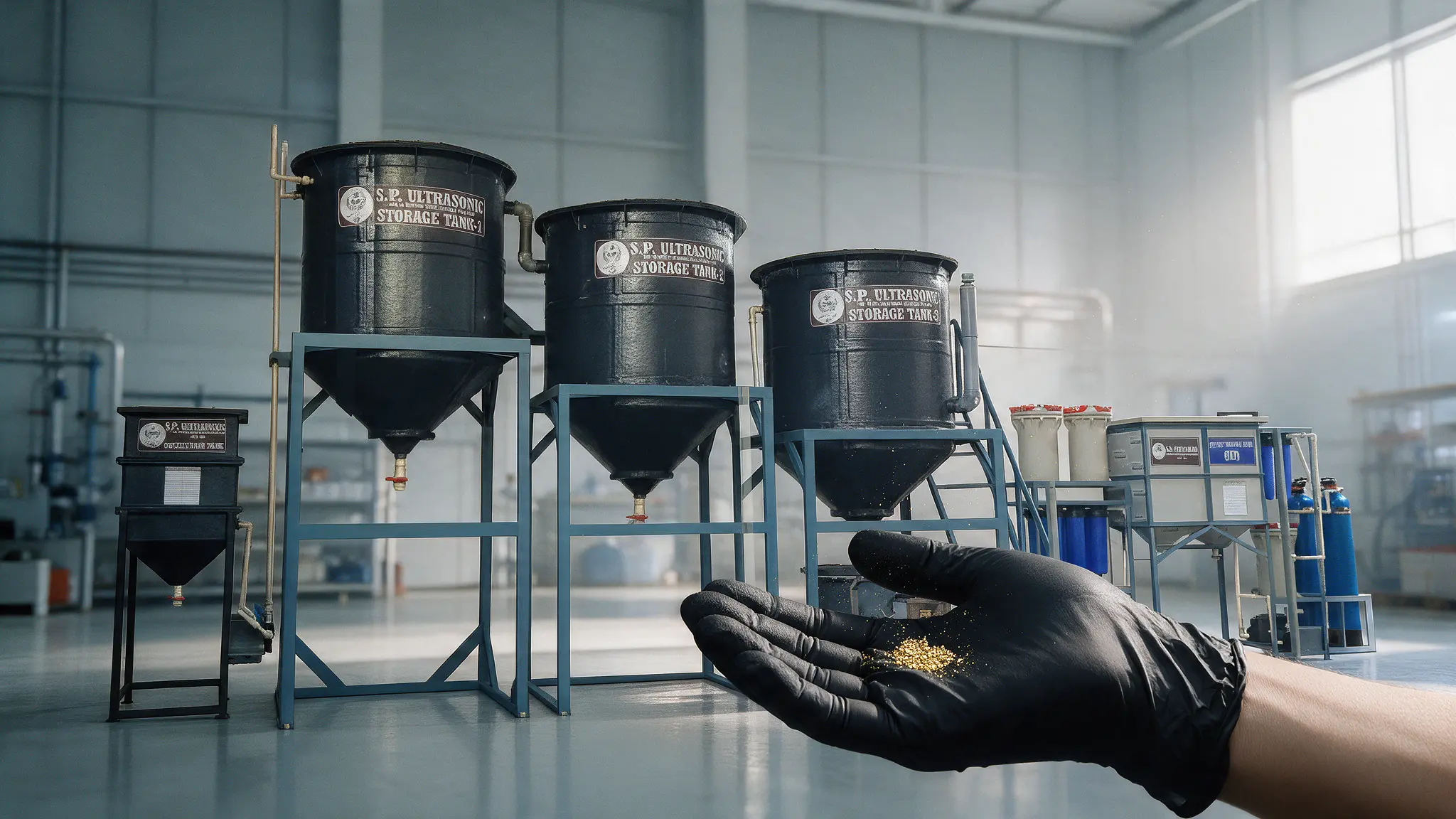
Learn more about the science of settling tanks in jewellery manufacturing, how they work, and why they matter for sustainable production.
Jewellery manufacturing combines creativity with precision. However, behind the beauty of finished jewellery lies an important process that is often overlooked: waste management. This is where the settling tank plays a vital role. It helps collect wastewater, separate suspended solids, and support precious metal recovery in jewellery workshops.
What’s a Settling Tank?
A jewellery settling tank is specialised equipment designed to manage wastewater generated during jewellery manufacturing. It helps separate solid particles from water, reducing metal loss and supporting responsible waste management.
A typical settling tank includes:
P.P. Tank: Used for primary wastewater collection.
S.S. Basin: Used for washing operations.
Depending on its design, the system may also include internal partitions, pumps, and filtration components to improve wastewater treatment.
The Science of Sedimentation
Settling tanks work on the principle of sedimentation, a physical process that separates suspended particles from liquids using gravity. Heavier particles settle at the bottom, while water moves through the tank.
Several factors influence sedimentation efficiency, including particle size and density, water temperature and viscosity, tank design, and wastewater flow rate.
Sludge Removal
As particles settle, they accumulate as sludge at the bottom of the tank. This sludge may contain valuable metals such as gold and silver. It can be collected, dried, and sent for appropriate refining to recover the precious metals.
Regular sludge removal helps maintain the tank’s effective capacity and supports efficient operation.
Working of Settling Tanks
A settling tank typically operates through the following stages:
Wastewater Collection: Wastewater from jewellery cutting, polishing, washing, and cleaning operations enters the tank.
Sedimentation: Gravity allows heavier suspended particles to settle at the bottom.
Filtration: A suitable filter, such as a dish cartridge filter, captures additional particles that remain suspended.
Water Recycling: Depending on the treatment system and water quality, the treated water may be reused for suitable applications.
Internal partitions, available in two or three-partition configurations, help control water flow and create additional settling zones. This can reduce turbulence and improve the separation of suspended solids.
Why Settling Tanks Matter in Jewellery Manufacturing
Recovery of Precious Metals
Settling tanks help collect metal-bearing particles that might otherwise be lost through wastewater. Recovering these materials can reduce precious metal wastage.
Environmental Protection
By collecting suspended solids before wastewater is discharged or reused, settling tanks support better waste management and help reduce the release of metal-bearing particles into the environment.
Cost Savings
Recovering valuable metals and reusing suitably treated water can help reduce material losses and water consumption, depending on workshop operations.
Regulatory Compliance
Proper wastewater management helps jewellery manufacturers meet applicable environmental requirements. Additional treatment may be necessary depending on local regulations and discharge standards.
Features of Modern Settling Tanks
Modern settling tanks can include practical features designed to support efficient workshop operations, such as:
Kirloskar pumps: Certain configurations include built-in 1 HP pumps for water circulation.
Automatic on/off controls: Help manage pump operation and reduce unnecessary energy consumption.
Flexible configurations: Different options can accommodate workshop layouts and operational requirements.
The available features depend on the selected model and configuration.
Selecting the Right Settling Tank
Choosing the right settling tank requires careful consideration of your workshop’s needs. Evaluate the volume of wastewater generated, the type of particles present, available installation space, filtration requirements, and budget.
It is also important to consider maintenance access, sludge removal, and future production requirements. Selecting suitable equipment can help improve wastewater management and support long-term operational efficiency.
Frequently Asked Questions
1. What is a settling tank used for in jewellery manufacturing?
It collects wastewater and helps separate suspended solids, including precious metal particles, through sedimentation and filtration.
2. Can settling tanks recover gold from wastewater?
Yes, they can collect some gold-bearing particles in the sludge. Further refining may be required to recover the gold.
3. How often should a settling tank be cleaned?
Cleaning frequency depends on wastewater volume and sludge accumulation. Regular inspection helps determine when cleaning is necessary.
4. Can water from a settling tank be reused?
Yes, when the treated water meets the quality requirements of the intended application. Additional treatment may be needed.
Conclusion
Settling tanks are an important part of effective jewellery manufacturing waste management. By supporting precious metal recovery, improving wastewater handling, and enabling suitable water reuse, they help workshops operate more efficiently and responsibly.
Looking for a settling tank for your jewellery workshop? Explore our settling tank solutions to find an option suited to your operational needs. Contact us to learn more about the available configurations and features.